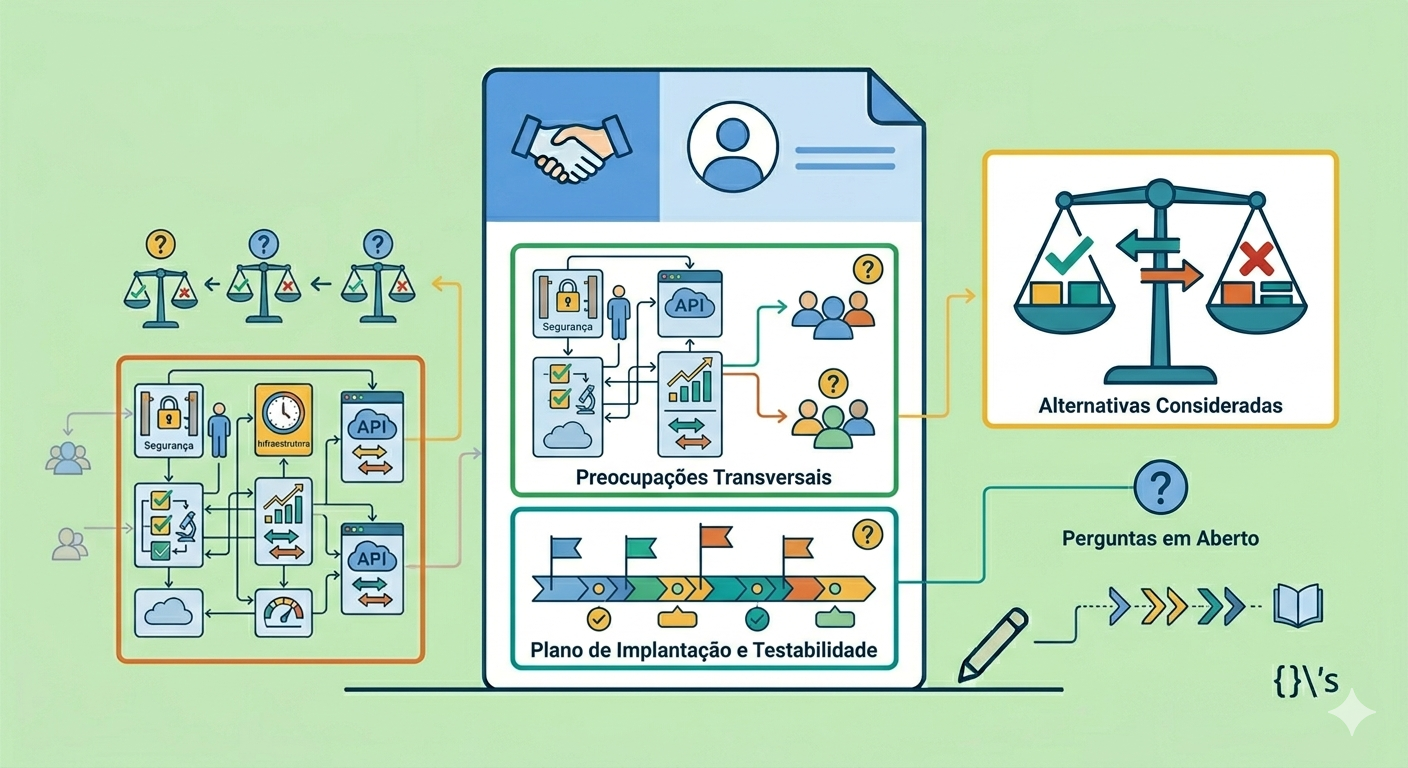
In part 2 we described and justified the design of the solution. But a good document also shows the paths you didn’t take and what your solution affects beyond your own team.
⚠️ A quick reminder: the sections that follow are examples and recommendations, not a mandatory template.
Alternatives considered Link to heading
Here you list the alternative systems or solutions you evaluated, explaining the trade-offs and the reasoning behind the final choice.
Alternatives considered
Do nothing. Keep the manual process with spreadsheets. Ruled out, because it doesn’t solve the recurring stockouts and doesn’t scale as the catalog grows.
Heuristic rules (reorder-point replenishment). Simple to implement, but it doesn’t capture seasonality or promotional events. Estimated MAPE around 35%, above the acceptable threshold.
✓ Batch predictive model (chosen). Balances cost, accuracy, and delivery timeline. Expected MAPE ≤ 15%, reusing the existing infrastructure.
💡 Tips:
- One alternative that’s always worth considering is doing nothing. Document why you ruled it out.
- The focus should be on the trade-offs of each option and how they led to the chosen solution.
- Be concise, but make it clear why the chosen solution is the best one given the project’s constraints.
Cross-cutting concerns Link to heading
Describe what might affect people beyond your team: security, API compatibility, increased load on other systems, infrastructure. This ties directly into collaborating with the teams involved in or impacted by the solution.
Cross-cutting concerns
Security. Per-store sales data is sensitive. Access to the feature table is restricted by IAM to the ML Engineers group. The dashboard uses row-level security by region.
Infrastructure. The inference job increases BigQuery slot consumption by roughly 15% while it runs (4 AM to 6 AM). Aligned with the Platform team.
Compatibility. The recommendations table follows the schema agreed with the Analytics team. Future schema changes require versioning and advance communication.
💡 Tips:
- Get the teams involved as early as possible. Late surprises lead to rework and delays.
- Ask the impacted teams for reviews. They spot problems your team can’t see.
Other (wrapping up) Link to heading
A few short sections tend to round out the document nicely.
Testability and observability. How the solution will be tested and how metrics will confirm success, including how it will be observed in production.
Tests: backtesting over the last 6 months and integration tests through Airflow’s CI. Metrics: MAPE ≤ 15% and a stockout reduction of ≥ 20% within 90 days. Observability: Datadog alerts for pipeline failures and latency above 2h.
Rollout plan. How the deliverables are broken down and the steps to deliver value incrementally and safely.
- Pipeline and feature table in production (weeks 1 and 2).
- Model training and validation (weeks 3 and 4).
- Pilot with 5 stores (weeks 5 and 6).
- Full rollout (week 7).
Open questions. Points that are still undefined or unknown. They signal honesty and invite collaboration.
- How should we handle products with less than 30 days of history?
- What’s an acceptable SLA for a delay in the pipeline? Waiting on alignment with Operations.
- Should the model support multiple horizons (7, 14, and 30 days) in this version?
Until next time Link to heading
With that, the content of the document is complete. In part 4 we move away from “what to write” and look at the process: the life cycle of a design doc, when it’s not worth writing one, and other types of document that live alongside it.
So that’s it, folks!
See you next time!
{}’s